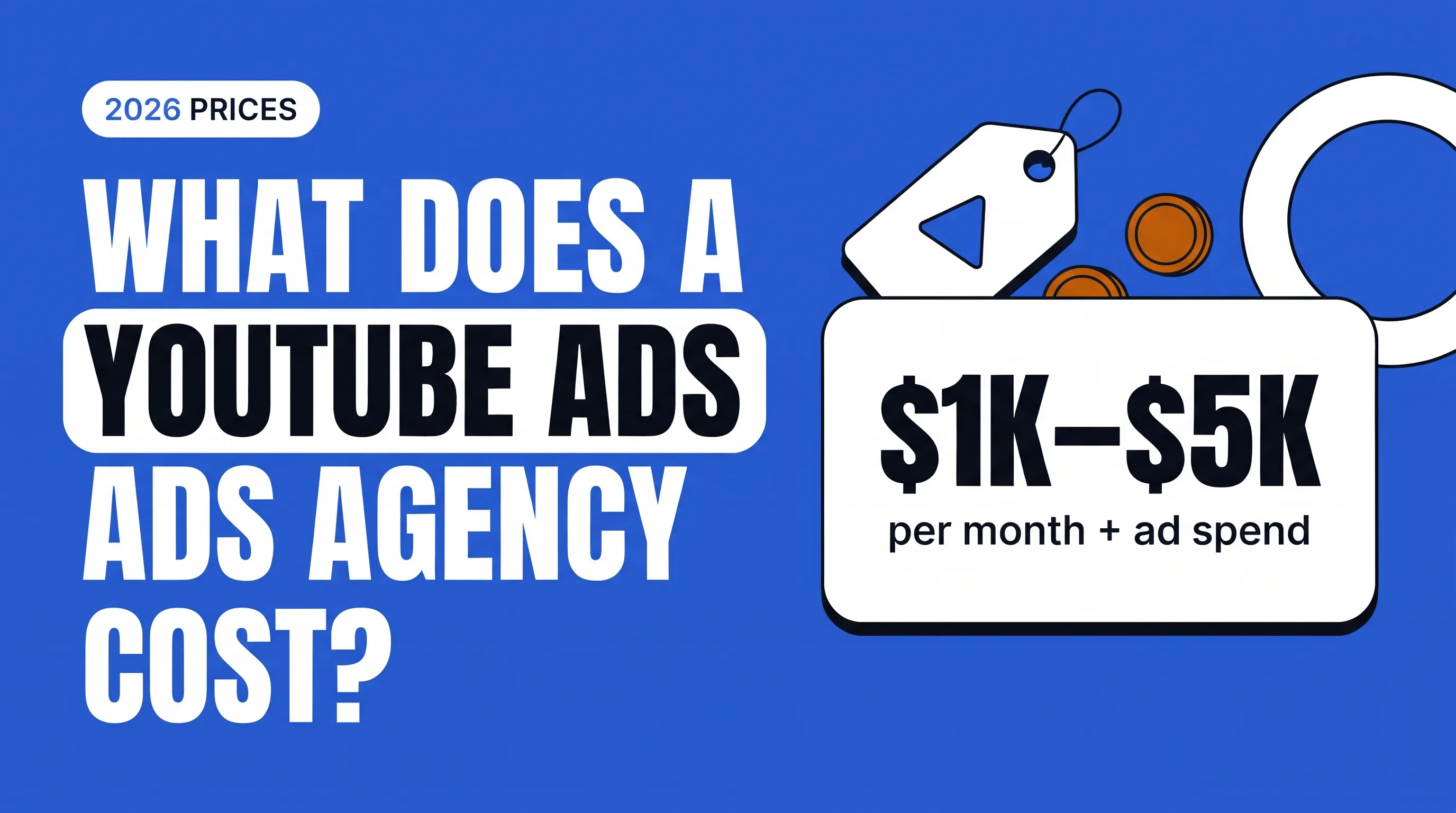
A YouTube ads agency usually costs $1,000 to $5,000 a month for a small or mid-sized business. That is the agency's fee only. The money you spend on the ads themselves is a separate bill paid to Google.
In our October 2026 review of publicly listed agency prices, most YouTube ads agencies started between $1,000 and $3,000. Agencies that bill as a share of your budget usually take 10% to 20% of monthly ad spend, and some YouTube specialists quote 15% to 25%.
Bigger brands that want strategy, ad production and testing in one package often pay $5,000 to $12,000 or more a month on top of ad spend.
Your own number depends on three things: how the agency charges, how much you plan to spend on ads, and whether you need them to make the videos. Each one is covered below, followed by three sample budgets you can copy.
You pay two bills: the agency and Google
Every YouTube ads budget splits into two parts. The first is the agency's fee for strategy, setup, targeting, testing and reporting. The second is your ad spend, which goes straight to Google Ads, usually charged to your own card or invoice.
This is where most quotes get confusing. One agency says "$1,500 a month" and means the fee only. Another says "$5,000 a month" and means fee plus ad spend combined. Before you compare two quotes, ask each agency to split them.
A few agencies buy the media for you and bill you one total. That can work, but ask to see the Google Ads invoices. Otherwise you can't tell how much of your money reached YouTube.
The four ways YouTube ads agencies charge
Most agencies use one of four pricing models. Flat monthly retainers are by far the most common. In a Credo survey (opens in a new tab) of 146 firms that run paid ads, about 83% billed a flat retainer and about 13% billed only a percentage of spend.
| Model | How it works | Typical range | Best for |
|---|---|---|---|
| Flat monthly retainer | Same fee every month, whatever you spend | $1,000 to $5,000 a month for most small and mid-sized accounts | Steady budgets, businesses that want a predictable bill |
| Percentage of ad spend | Fee is a share of what you spend that month | 10% to 20% of spend, often with a minimum of about $500 | Accounts spending $10,000+ a month that plan to scale |
| Hybrid | A base fee plus a smaller percentage | Example: $1,000 base plus 5% of spend | Budgets that change a lot month to month |
| Per project or per video | One price for a campaign launch or each ad video | $1,000 to $3,000 per project; $1,500 to $10,000 per produced video | One-off launches, testing an agency before a retainer |
Ranges come from Clicksgeek (opens in a new tab), MarketerHire (opens in a new tab) and our October 2026 review of agency prices.
Performance pricing exists too, where the agency is paid per lead or per sale. It is rare for YouTube because video ads often drive sales that show up later through search or direct visits, which makes the credit hard to agree on.
Flat fee or percentage: the break-even point
To compare a flat quote with a percentage quote, divide the flat fee by the percentage:
\text{Break-even ad spend} = \frac{\text{flat monthly fee}}{\text{percentage rate}}Say Agency A quotes $1,500 a month and Agency B quotes 15% of spend. $1,500 divided by 0.15 is $10,000. Below $10,000 a month in ad spend, Agency B costs less. Above it, Agency A does.
Keep one thing in mind with percentage pricing: the agency earns more when you spend more, whether or not the extra spend is profitable. That doesn't make it a bad model, but it means you should agree on a target cost per lead or return on ad spend before you raise the budget.
Starting prices are a floor. Your quote will rise with ad spend, the number of ad videos you need, and how many campaigns run at once. For a wider sample, Clutch (opens in a new tab) reports minimum project sizes from $1,000 to over $50,000 across thousands of YouTube advertising firms, with $100 to $149 an hour as the most common rate.
What the ads themselves cost
YouTube ads are usually cheap per view. Across industries, the average cost per view is about $0.026 and the average cost per 1,000 impressions is about $3.53, according to Mega Digital's benchmark data. Competitive niches cost more: healthcare and insurance had the highest average view cost in the same data, at $0.071.
| Ad format | How you pay | Typical cost |
|---|---|---|
| Skippable in-stream | Per view (30 seconds watched, the full ad if shorter, or a click) | $0.02 to $0.30 per view |
| Non-skippable in-stream | Per 1,000 impressions | $6 to $10 CPM |
| Bumper (6 seconds) | Per 1,000 impressions | $10 to $20 CPM |
| In-feed video | Per view (thumbnail click) | About $0.10 per view |
| Shorts | Per 1,000 impressions | About $4 CPM |
| Masthead (top of homepage) | Reserved through Google sales | $300,000 to $1M+ |
Sources: Mega Digital cost guide (opens in a new tab), JoinBrands (opens in a new tab), Top Growth Marketing (opens in a new tab).
What most small businesses actually spend is modest. In a WebFX survey (opens in a new tab) of 270 marketers, 53% of businesses spent between $101 and $1,000 a month on YouTube ads.
A cheap view isn't automatically a good one. Work backward from what a customer is worth. If you can afford to pay $40 to win a customer and 0.5% of viewers convert, you can pay up to $0.20 a view and still make your target.
Three sample monthly budgets
These are worked examples built from the ranges above, not quotes. Use them to sanity-check what an agency sends you.
| Scenario | Ad spend | Agency fee | Ad videos | Total per month |
|---|---|---|---|---|
| Local business testing YouTube (clinic, law firm, trades) | $1,500 | $1,000 flat retainer | Uses one existing video | $2,500 |
| Growing e-commerce or SaaS brand | $10,000 | $1,500 (15% of spend) | 2 new ads at about $1,000 each | $13,500 |
| Established brand running several campaigns | $50,000 | $4,500 (hybrid: $2,000 base plus 5%) | About $5,000 of new creative | $59,500 |
In the first scenario, the agency fee is two-thirds of the ad spend. That ratio is normal for small tests, but it means you're mostly paying for setup and learning. Plan to run it for at least three months before you judge results.
In the third, the fee is under 10% of the total. Past a certain size, the cost that matters most is ad spend that isn't working, so the agency's testing process matters more than its fee.
Extra costs to ask about
The monthly fee rarely covers everything. Ask each agency whether these are included:
Setup or onboarding fees in the first month, for building campaigns, audiences and conversion tracking.
Video production. Agencies that make ads charge anywhere from about $1,000 per video to $10,000 for a fully produced spot.
New ad versions. Ads wear out as the same people see them again. Ask how many new versions per month the fee includes.
Revisions beyond the agreed rounds on each video.
Stock footage and music licences, which can add a few hundred dollars a month.
Tracking and reporting tools, if the agency passes software costs on to you.
Early exit fees on longer contracts.
If a quote doesn't mention production at all, assume you will need to supply the videos yourself.
When an agency is worth it, and when to run ads yourself
An agency usually pays for itself when at least two of these are true:
You can spend $1,500 or more a month on ads for at least three months.
You don't have ad videos yet, or the ones you have were made for organic posting.
Nobody on your team has set up conversion tracking in Google Ads before.
You sell something with a clear value per customer, so results can be measured in leads or sales.
If your budget is a few hundred dollars a month, an agency fee will likely cost more than the ads. You'll learn more by running a small campaign yourself in Google Ads, or by paying a freelancer for a one-time setup. MarketerHire (opens in a new tab) makes a similar point: an agency that takes on an account spending around $1,500 a month is mostly selling its time, because YouTube campaigns need enough volume to learn.
One rule applies at any budget: the Google Ads account should be in your name. If you part ways, you keep the history, audiences and conversion data.
How to compare agency quotes
Get at least three quotes, then put them side by side using the same questions:
Is this price the fee only, or fee plus ad spend?
Which pricing model is it, and what happens to the fee if my ad budget doubles?
How many new ad versions do you test each month?
Is video production included? If not, what does one ad video cost?
Who owns the Google Ads account and the YouTube channel?
What is the minimum contract, and what does it cost to leave early?
Which one or two numbers will you report on? Cost per lead and return on ad spend are more useful than views.
Can you show results from a business like mine, with real numbers and links?
Run the break-even formula from earlier on any percentage quote, then look at the total for your planned budget, not the headline fee.
FAQ
How much should a small business spend on YouTube ads?
Many small businesses start between $100 and $1,000 a month; 53% of businesses in a WebFX survey spent in that range. If you're hiring an agency, budget at least $1,500 a month in ad spend so the campaign has enough data to improve.
Is the ad spend included in the agency's fee?
Usually not. Most agencies charge their fee separately, and you pay Google directly for the ads. Always ask, because some quotes combine both.
Is a percentage-of-spend fee a bad deal?
Not by itself. It's often cheaper than a flat fee at low budgets and more expensive at high ones. Use the break-even formula to see where your budget falls.
Is there a minimum ad spend on YouTube?
Google doesn't set a minimum. Agencies often do, because small budgets don't give them enough data to test and improve.
How long before YouTube ads show results?
Expect the first month to go to setup and early testing. Most agencies and advertisers judge results after about three months of steady spend.
Do YouTube ads agencies make the videos?
Some do and some don't. Ask before you sign, since production can cost more than management.