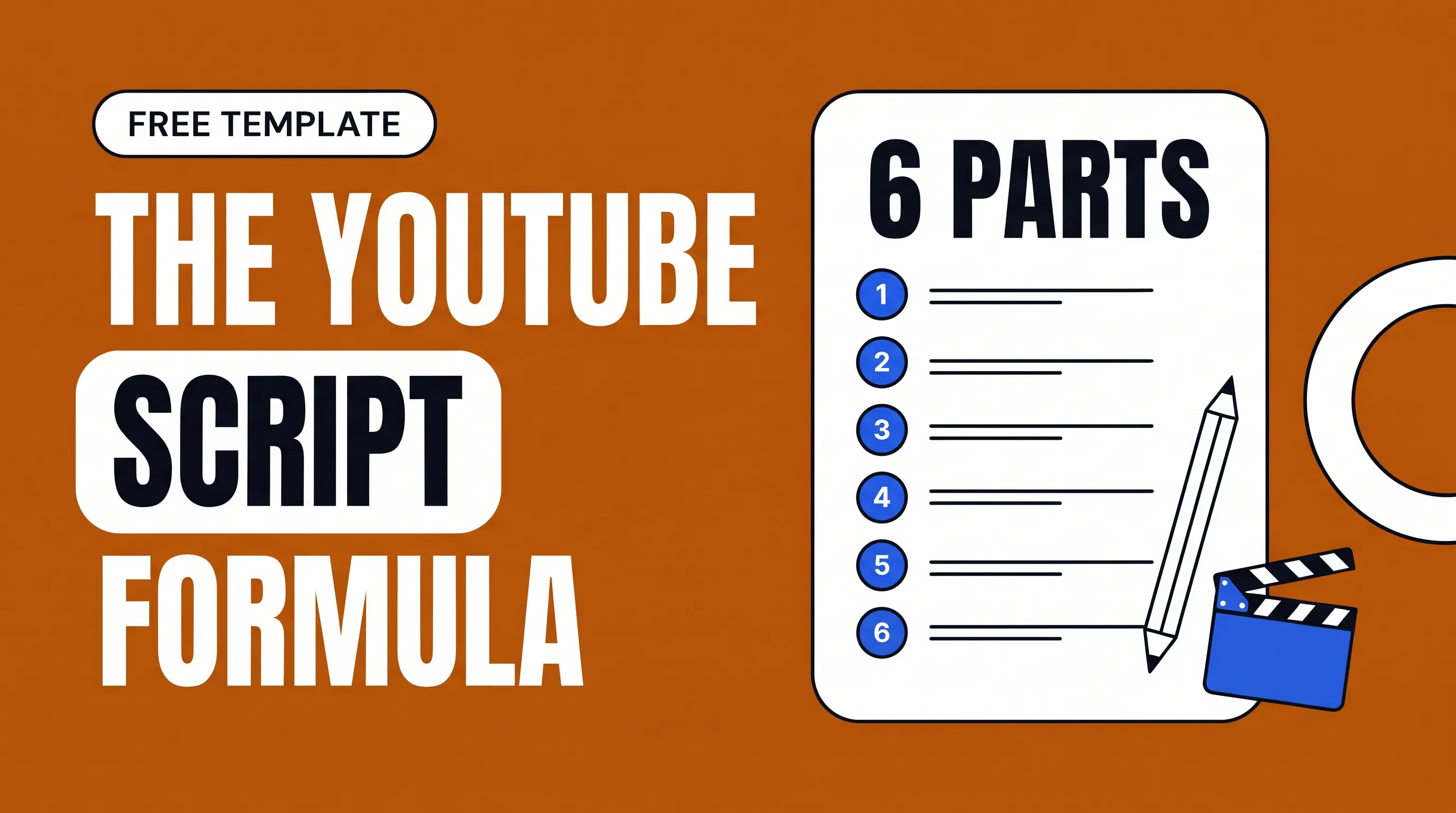
A good YouTube script for a business follows six parts, in this order:
Hook: name the viewer's problem in the first 10 seconds.
Promise: say what they'll know by the end, and why you're the one to tell them.
Problem: explain why the problem matters or what it costs them.
Answer: the main content, in three to five clear steps or points.
Proof: one real example, number or customer story.
Next step: one call to action that fits where the viewer is.
The structure works because it matches what a viewer asks themselves, in order: is this for me, can I trust this person, do I care, what's the answer, does it work, and what now? Business owners usually get the answer right and skip the hook and next step, which are the two parts that bring in customers.
The six parts, with timings
Timings below are for an 8-minute video. At a natural speaking pace of roughly 140 to 160 words a minute, that's a script of about 1,200 words.
| Part | Time | Rough word count | What it must do |
|---|---|---|---|
| 1. Hook | 0:00 to 0:10 | 25 | Make the right viewer think "this is about me" |
| 2. Promise | 0:10 to 0:30 | 50 | Say what they'll get and why to trust you |
| 3. Problem | 0:30 to 1:15 | 110 | Make the cost of the problem concrete |
| 4. Answer | 1:15 to 6:30 | 800 | Deliver the steps or points, one at a time |
| 5. Proof | 6:30 to 7:30 | 150 | Show it working with a real example |
| 6. Next step | 7:30 to 8:00 | 75 | Tell them exactly what to do now |
1. Hook (first 10 seconds)
Start with the viewer's problem or the result they want, in their words. Skip the logo animation, "Hi everyone, welcome back" and your life story.
Weak: "Hi, I'm Dr. Patel from Smile Dental, and today we're talking about implants."
Strong: "If you've been told you need a dental implant and the price shocked you, here's what you're actually paying for."
2. Promise and credibility (10 to 30 seconds)
Tell them what they'll know by the end, then give one line of credibility. "By the end you'll know the five costs in an implant quote and which ones you can negotiate. I've placed over 2,000 implants in 15 years, so I've seen every kind of quote." One sentence of credentials is enough.
3. The problem (30 seconds to about 1 minute)
Show why this matters with a concrete cost: money lost, time wasted, a risk they hadn't considered. This keeps viewers through the slower middle of the video.
4. The answer (the bulk of the video)
Break the content into three to five numbered points or steps, and say the number up front: "There are five costs in every implant quote." Give each point a one-line headline, then explain it with a specific example. Add a chapter timestamp for each one in the description.
5. Proof
One real story or number beats three general claims. A customer's before and after, a real quote broken down, or a result with numbers attached. Get permission before naming anyone.
6. Next step (last 30 seconds)
Give one call to action, matched to the viewer's stage:
Early-stage viewers: "Watch this video next" (with an end screen).
Comparing options: "Download the checklist in the description."
Ready to buy: "Book a free consultation, link below."
One clear action works better than "like, subscribe, comment, visit our site and follow us on Instagram".
Fill-in script template
Copy this and fill in the brackets. Most business owners can finish it in under an hour.
TITLE: [The exact question or result, in the customer's words]

1. HOOK (10 sec)
"If you [situation the viewer is in], [the surprising fact, mistake or result]."

2. PROMISE (20 sec)
"In this video you'll learn [specific outcome].
I'm [name], I [one line of credibility: years, number of clients, result]."

3. PROBLEM (45 sec)
"Most people [common mistake]. That usually costs them [money, time or risk]."

4. ANSWER (3 to 5 points)
"There are [number] things to know."
Point 1: [headline] - [explanation] - [example]
Point 2: [headline] - [explanation] - [example]
Point 3: [headline] - [explanation] - [example]

5. PROOF (1 min)
"Here's what happened when [customer] [did this]: [result with a number]."

6. NEXT STEP (30 sec)
"If you [viewer's situation], [one action] - the link is in the description."
Worked example: a roofing company
Title: How Much Does a New Roof Cost in 2026? (Real Quote Breakdown)
Hook: "If you've had two roofing quotes that are $8,000 apart, here's exactly why, line by line."
Promise: "By the end you'll be able to read any roofing quote and spot padding. I'm Mike, and my team has replaced over 1,500 roofs in Columbus."
Problem: "Most homeowners pick the cheapest quote, then pay again in five years when the shortcuts show."
Answer: "Every quote has five parts: materials, tear-off, underlayment, flashing and labor." Each part gets 60 to 90 seconds with a photo from a real job.
Proof: "Here are two real quotes for the same house. The cheaper one left out new flashing, a $1,200 repair waiting to happen."
Next step: "If you've got a quote and you're not sure about it, send it to us for a free second opinion. Link below."
The names and numbers above are illustrations; use your own real ones.
Common script mistakes
Opening with your logo, name and company history instead of the viewer's problem.
Covering three topics in one video. One question per video ranks and converts better.
Writing like a brochure. Read your script aloud; if you wouldn't say it to a customer across the counter, rewrite it.
Asking for five actions at the end. Pick one.
Reading word for word in a flat voice. Use the script to plan, then speak from bullet points.
Tips for owners who don't like being on camera
Script the first 30 seconds word for word and speak the rest from bullet points. The opening is where nerves show most.
Film in short sections. You can cut between them in editing.
Talk to one real customer in your head, not "the audience".
Use a teleprompter app on your phone or tablet for long sections.
If you'd rather not appear at all, show your hands doing the work, a screen recording, or photos with a voiceover.
FAQ
How long should a YouTube script be for a business video?
For most how-to and explainer videos, 6 to 12 minutes, or roughly 900 to 1,800 words. Long enough to answer the question fully, and no longer.
Should I write a script word for word?
Write the hook and call to action word for word. For the middle, bullet points usually sound more natural on camera.
How do I write a script for a YouTube Short?
Use the same structure squeezed down: a hook in the first second, one point, and a next step, usually pointing to a long video. Aim for 30 to 60 seconds.
How do I find topics to script?
List the questions customers ask on sales calls and in emails, then check YouTube's search suggestions for how they phrase them. Each question is one script.
Can AI write my YouTube scripts?
AI tools can help with outlines and first drafts. Add your own examples, numbers and opinions, though, because those are what make viewers trust you over a competitor.