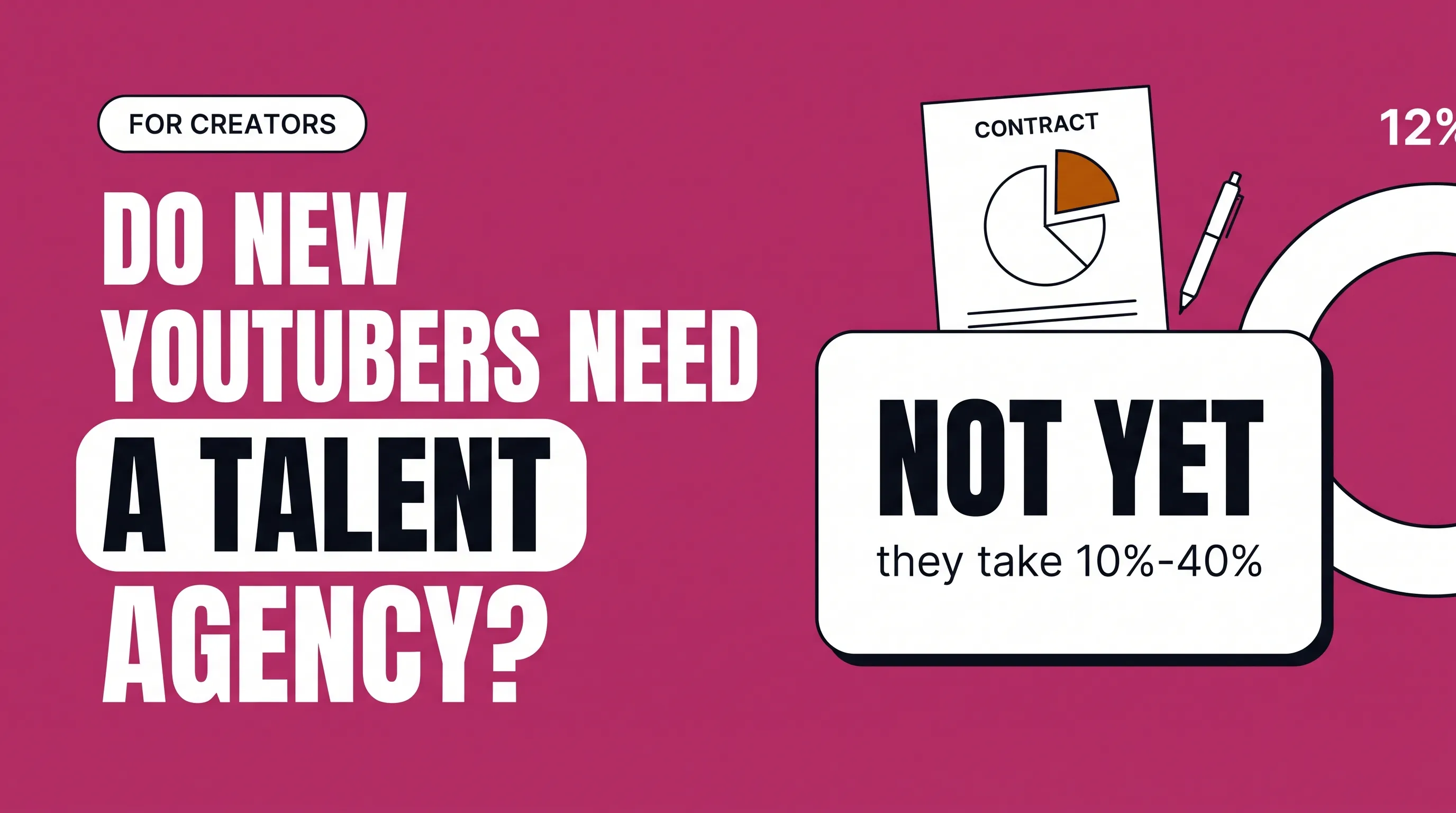
Yes, there are talent agencies and creator management companies that work with new YouTubers, but most new channels don't need one yet. Talent agencies mainly sell brand deals, and brands pay for audiences. Until you have steady views, an agency has little to sell and will either turn you down or take a cut for very little.
What helps a starting channel more is skill-specific help: an editor, a thumbnail designer or a one-off channel audit, paid by the job with no share of your future income. Bring in a manager or agency once brand inquiries start arriving faster than you can handle them.
The four kinds of help, and what each takes
"Talent agency" gets used for several different businesses. They work differently and charge differently:
| Type | What they do | How they're paid | Typical cut |
|---|---|---|---|
| Talent agency | Finds and negotiates brand deals, sometimes TV, books or speaking | Commission on deals they bring | Around 20% to 30% for full-service talent management |
| Freelance manager | One person handling your inbox, deals and scheduling | Commission | Around 10% to 15% |
| MCN (multi-channel network) | Groups many channels; may offer rights management, tools, sponsorship sales | Share of your channel revenue | Roughly 10% to 40%, often including ad revenue |
| Growth agency or freelancer | Editing, thumbnails, strategy, audits | Flat fee per job or per month | No share of income |
Commission ranges: EarnifyHub (opens in a new tab) for talent managers, Interspace Music (opens in a new tab) for MCNs.
Why MCNs cost more than they look
YouTube pays creators 55% of net ad revenue on long-form videos. Joining an MCN doesn't change that split; the network takes its cut from your 55% before it reaches you. A 30% MCN cut on $1,000 of ad revenue leaves you $700, before any separate commission on sponsorships.
Most of what MCNs once offered, like analytics, copyright tools and direct monetization, is now available to any creator in the YouTube Partner Program at no extra cost.
The real first milestone: the Partner Program
Before you think about agencies, aim to join the YouTube Partner Program. The bar is 1,000 subscribers plus either 4,000 public watch hours in a year or 10 million Shorts views in 90 days. From February 1, 2027, new applicants will need 8,000 watch hours or 20 million Shorts views instead; channels already in the program aren't affected. If you're close to the current bar, it's worth pushing to qualify before that date.
What a startup channel should do instead
| Channel stage | What actually helps | Typical cost |
|---|---|---|
| 0 to 1,000 subscribers | Post consistently; get feedback from other creators; one channel audit after 10 to 20 videos | Free to a few hundred dollars |
| 1,000 to 10,000 | A freelance editor or thumbnail designer to free up time; join the Partner Program | Paid per video |
| 10,000 to 50,000, first brand emails | Handle deals yourself with a simple rate card; consider a freelance manager if deals arrive weekly | 10% to 15% commission if you hire one |
| 50,000+ with regular brand demand | A talent agency or full manager | 20% to 30% of deals |
Two other free options: YouTube's own creator marketplace lets eligible Partner Program creators receive brand inquiries inside YouTube Studio, and creator communities and Discord groups often share rates and vetted contacts.
Red flags to walk away from
They ask you to pay an upfront "signing" or "onboarding" fee to represent you.
They promise a number of subscribers or views. Nobody can guarantee that.
They contact you first with a generic message when your channel is tiny. Real agencies rarely chase channels with no brand demand.
The contract takes a percentage of all income, including ad revenue, memberships and merch, not only the deals they bring.
The contract runs for years with no exit clause, or claims ownership of your channel or content.
They want your channel password instead of access through YouTube's permissions.
They call themselves a "network" but can't explain what they'll do in your first 90 days.
Checklist before you sign anything
Which income does the commission cover: only deals they bring, or everything?
What's the commission rate, and does it drop as you grow?
How long is the contract, and how do you exit early?
Do they keep earning on deals after the contract ends, and for how long?
Who owns the channel, the videos and the audience data? (It should be you.)
What will they deliver in the first 90 days, in writing?
Can you speak to two creators they currently represent at your size?
Has a lawyer or an experienced creator read the contract?
FAQ
Are there talent agencies for YouTubers starting out?
Yes, but few take on very small channels, because their income comes from brand deals. Channels with a few thousand subscribers usually get more from paying for editing or an audit than from giving away a percentage.
How many subscribers do you need to get a talent agency?
There's no fixed number. What matters is steady views and brand interest. Many creators start talking to managers once they get regular sponsorship inquiries, often somewhere past 10,000 to 50,000 subscribers in a niche brands care about.
Is an MCN worth it for a small channel?
Rarely. MCNs take a share of revenue, often including ad revenue, and most of their old tools are now free to Partner Program members. Read any MCN contract closely before signing.
Do talent agencies help you grow?
Mostly no. Talent agencies sell your existing audience to brands. Growth comes from better videos, titles and thumbnails, which is what editing, packaging and audit specialists help with.